Books

Fiction: Apocalypses - Volume I
Published: 2024
Apocalypses Volume I: "The complete and final destruction of the world, as described in the biblical book of Revelation."
Christ's Second Coming motivates several characters during the Civil War battle of Fredericksburg. They assume the bloodbath of December, 1862, is the biblical Armageddon, and that Confederate General Stonewall Jackson will be revealed as Christ come again. The Apocalypse also figures in 2nd Century Asia Minor, where a certain Montanus believes he is the incarnation of God the Father, and that his two female disciples form a new Trinity, who will orchestrate the world's end. The eras unite first by a magical talisman, which is thought to have healing, resurrecting, and prophetic properties; and second, by a demonic girl who first appears on the battlefield.
In the novel, the word 'Apocalypse' also connotes radical, psychological shifts: A slave rejects his paradoxical thought world by escaping North in a railroad crate, having spent his early years raised by a white mother, the wife of a plantation owner, while 'playing' the slave fully when he is auctioned to a new master as an adolescent. Reality upends as a doubting Protestant cleric-grief stricken at the loss of his young daughter-embraces revenge. A prim, finishing school mistress willingly enters the dark realm of a murderous stranger, rejecting her past for a sudden and seemingly inexplicable romance. A street preacher abandons his apocalyptic obsession for one greater: a young, black woman he spots on an auction block in Richmond and madly pursues-a passion which, in the end, offers purpose and hope.
The novel follows the medieval poet Dante Alighieri's (1265-1321) tripartite division of his "Divine Comedy": Volume 1 represents 'The Inferno'-the battle of Fredericksburg and its immediate aftermath. Volume 2 contains 'Purgatorio' and 'Paradiso'-walking through desolation in the former and attaining heaven in the latter. The novel subverts the poet, however, suggesting that hell and heaven confront us fully in this life. Dante's paramour, Beatrice, who he barely knew, plays out in several love sequences, suggesting that love is most powerful when it is immediate and irrational.
The author combines the suspense of a Stephen King with the war narrative of a Stephen Crane. There is moral urgency here, and theological probing, which, I believe, Melville and his whale would appreciate."
Novelist - Luis Perez
A bloody American Civil War battle drives a handful of characters into unexpected situations in Gram’s historical novel. An engrossing and measured novel of wartime."
Kirkus Reviews February 13, 2024
"Graduate schools cannot teach the intuitive and masterful way Gram writes. His prose is beautiful."
"Don't let the high-fallutin' jacket copy fool you, this is simply one of the most beautifully written books I've ever read. The characters, the descriptions, everything about this book is done on such a high level. Just start reading and you'll see exactly what I mean!"
Steve Hamilton, Two time Edgar Award Winner, Bestselling Author, Two of whose books were New York Times Notable Books of the Year.
"Another thought provoking piece of work by Dr. Gram! Incredibly well researched and amazing character development."
Sarah Sullivan, Amazon Reader
"Apocalypses volumes I and II are packed full of history, theology, and mythology without being dry or preachy. Intrigue and action abound, and the well-developed characters and plot twists will keep you engrossed. These books are not for the squeamish as the detailed, descriptive prose propels the reader onto battlefields; you can almost smell the smoke and taste the grit of the gunpowder. I strongly suggest purchasing both books together as the end of Volume I leaves you hanging. Beautifully written, this author paints with words."
Elizabeth W., Amazon Reader
"Robert Gram is the rare combination of a brilliant scholar, a deep thinker, and a creative writer. Apocalypses, Volume 1, showcases all these gifts in a manner that grips us, informs us, and leaves us considering our own apocalypses. It is a fascinating and sobering read, as we are inevitably shaken in ways that bring us to reflect on our person and place in an increasingly chaotic world. Gram's vocabulary is nothing short of stunning, and his grasp of detail draws the reader completely into the deep and turbulent motivations and actions of his characters, as they encounter the complete and collapsing terror of their physical circumstances. I eagerly look forward to reading Volume 2."
Anonymous, Amazon Reader
"Historical fiction at its best. Accurate and sometimes gruesome depiction of a civil war battle, the lead up and the aftermath. Great character development for period, I felt like I knew these people. I was engaged throughout. Well done, Bob, I can’t wait for the next one."
Lisa, Amazon Reader
"I enjoyed rereading many sentences of Gram's novel, as they were
so superbly written. Gram has an incredible command of language
and certainly of history: even the small things like describing boys strapped
above each front runner to keep ice boats on the Hudson from capsizing. The
descriptions and details became visual."
Dale Spencer (both volumes)
This two volume masterpiece, Tolstoyan in its range, goes against the
grain of contemporary novels: shorter with lesser themes, which occupy
contemporary bookshelves. It engages our deepest longings, fears, and
hopes. Given its length, it is surprising that the novel never lags. Throughout,
it is wonderfully suspenseful.
Ronald Killian
The battle scenes at Fredericksburg. All I can say is 'Wow!'
B. Harkney
Robert Gram is the rare combination of a brilliant scholar,
a deep thinker, and a creative writer. Apocalypses, Volume 1,
showcases all these gifts in a manner that grips us, informs us,
and leaves us considering our own apocalypses. It is a fascinating
and sobering read, as we are inevitably shaken in ways that
bring us to reflect on our own person and place in an increasingly
chaotic world. Gram's vocabulary is nothing short of stunning,
and his grasp of detail draws the reader into the deep and
turbulent motivations and actions of his characters, as they
encounter the deep and collapsing terror of their physical
circumstances.
Jerry Kennell
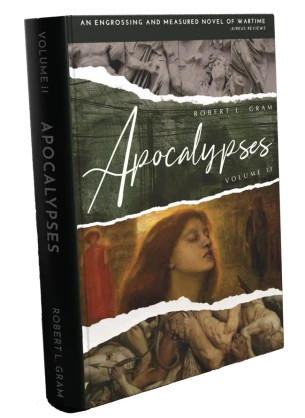
Fiction: Apocalypses - Volume II
Published: 2024
In the sequel, Reverend Conrad ver Meulen pursues his would-be murderer, Jean, from Fredericksburg to the interior of Turkey. Jean believes he is Montanus resurrected. Forming a new trinity with Corinne and another girl, Jean plans to orchestrate the Apocalypse on the holy mountain, Omercah-rising above the ancient ruins of Pepouza, the city where the Montanist movement began in the 2nd Century.
Conrad will discover Corinne on the journey and try to resurrect the seeming love they shared after the Battle of Fredericksburg. The minister will be afflicted by dreams about Marguerite Porete, burned at the stake in Paris as a heretic, on June 1st, 1310. What will this literate, medieval woman teach him about the nature of God? In his quest to hunt down Jean, Reverend Conrad will be joined by Samir, a young guide from the city of Smyrna, and Bucephalus—self-named—a precocious donkey.
Having escaped to Philadelphia, slave John will settle in Hurley, New York. Unknown to him, he will be pursued by his mixed race child, who is intent on establishing a father-daughter relationship, which was hidden from her in Fredericksburg. In the Second century, Montanus will attempt to escape his calling, as the incarnation of God, by fleeing to the city of Pergamum, and the great healing center there, to find cure for his delusion. He will be pursued by his teacher and mentor, who strong-arms him to resume his divine role. In Pergamum, Montanus will meet a strange, young woman, a follower of the goddess Athena, who will change the course of his life.
The sequel continues the medieval poet Dante Alighieri's tripartite division of his “Divine Comedy”: Volume 2 contains 'Purgatory' and 'Paradiso. The sequel raises the question of what Apocalypses mean, particularly in the lives of Reverend ver Meulen and Montanus. Are the phenomena they experience supernatural, or the result of hallucination? And does it really matter, if hope is the final result?
Great character development. Every chapter coaxes the reader forward into the unknown. Vivid descriptions of Fredericksburg, VA and Hurley, NY with the Civil War as a backdrop drop the reader right in the middle of life during that period in this nation's history."
Matthew W. July 2024
As always, Gram's mastery in describing scenery is practically peerless. One notes, especially, but not exclusively, the phrase 'vehement sun'.
J.D. Kent Ph.D. Retired Professor.
"It's wonderful to see that a simple donkey--self named Bucephalus after
Alexander the Great's horse--becomes a narrator and plays an important
role in the novel. As a child, I wept when I
read "Black Beauty". As an adult, tears flowed again when
I encountered dear Bucephalus and his great capacity to love."
Jennie Terpstra (Vol 2)
This two volume thriller has multiple endings, which combine the supernatural
with heartbreaking, yet hopeful realism. I've never read a novel with multiple endings. My favorite is when Corinne cries out to her father, a liberated slave, for forgiveness, having treated him shamefully as a child.
Valerie Coates (Vol 2)
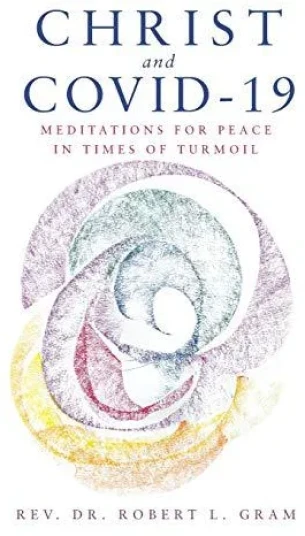
Non-Fiction: Christ and Covid-19
Published: 2020
A pastor compiles his daily writings to his Brooklyn parishioners during the first months of the Covid-19 pandemic in this work.
Though retired from full-time ministry, Gram agreed to serve as the interim pastor of St. John’s Reformed Church in Red Hook. The church’s full-time minister had suffered a medical emergency. Soon, what was supposed to be a brief stint in a waterfront neighborhood turned into a complicated endeavor, as the author dealt with the most tumultuous moments in the church’s history. The New York region was one of the first places in America seriously affected by a wave of Covid-19 infections. As church doors closed and home and hospital visits became impossible, the author shifted to daily meditations written for his parishioners. This timely book features minimally edited versions of those daily devotions written during the pandemic. In nearly 50 pieces, ranging from short paragraphs to lengthy essays, Gram provides readers with inspirational notes. Some of them address the holy season’s transition from a somber Lent to the hope promised by Jesus’ resurrection at Easter. There are also Covid-19 specific messages; for example, the author delivers a reminder that loving one’s neighbor includes staying indoors to limit the spread of the virus. Written just prior to George Floyd’s death, which Gram laments in his introduction, his daily musings sometimes discuss racism, particularly anti-Asian violence and rhetoric. A final essay concludes with the author’s vivid story of overcoming a genetic blood-clotting disorder. After the diagnosis, he became a prolific mountain climber and rode his bicycle from California to New Hampshire at the age of 68. Each devotion follows a predictable pattern of a relevant Scripture reference, a reflective vignette, and a prayer. Gram’s lucid writing style is that of a seasoned and intellectual yet nurturing pastor. Though the author is a mainline Protestant, he intentionally includes other faith traditions in his remarks, from Roman Catholicism to Buddhism. While the heartfelt book ends abruptly without a satisfying narrative conclusion, it will nevertheless be of great use to Christians struggling to make spiritual sense of the Covid-19 pandemic.
Though the author is a mainline Protestant, he intentionally includes other faith traditions in his remarks, from Roman Catholicism to Buddhism. Gram's lucid writing style is that of a seasoned and intellectual yet nurturing pastor...An uplifting, relevant devotional for finding hope in darkness."
Kirkus Reviews July 6, 2020
"Not only is this book a welcome resource for calm during this period of our history, but it is also an important hallmark of how the world is reacting and communicating while in quarantine."
Grady Harp, Amazon Hall of Fame Top 50 Reviwer, 5 stars
"With the world as it is, this book is sorely needed. The author has written with all the love and compassion you would expect from a man of God. His positive thinking and comforting reassurance that God does love us all."
Midwest Book Review, 5 stars
"If you're suffering under the weight of Covid-19, I highly recommend this book."
Rachel Song, Writer and Editor, 5 stars
"Rev. Gram has great insight and wisdom. His book guides us through
difficult times by centering our thoughts and cultivating hope."
Ron Van Dam, New England Broadcasting
"The diverse and distinct range of topics are truly phenomenal. ... These meditations are a cool balm to soothe the soul, and keep those of faith on the right track. They offer peace, better decision-making and compassion for all."
John Kelly, Detroit Free Press
"You offer the world something which relieves suffering...Christ and Covid-19
will still be valuable once we get back to normal life. This offering helps
regardless of the struggle people are going through.. Even the cover of
your book is so peaceful."
Kimberly Love 'Crashing 40' Impact Radio USA
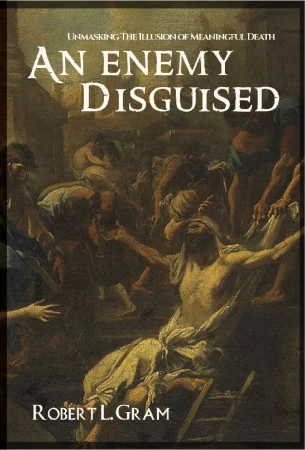
Non-Fiction: An Enemy Disguised - Revised
Completely Revised: 2025
New Forward from the Author
An Enemy Disguised is a dramatic document that systematically exposes the shallow lies of today's popular myths about the nature of death and dying.
After a decade of heart wrenching counseling with the terminally ill and their families, Robert L. Gram reveals the cruel hoaxes perpetrated by these man made "pop religions." Gram boldly calls to task the claims of the increasingly popular "Five Stage Dying Process" and other myths-budding religions that seduce patient and family alike, only to leave the survivors with bitter memories of those frightening final hours when the terminally ill patient wrestles at last with his own mortality.
An Enemy Disguised refutes those who offer a quick panacea for eternity, death merchants who seek to paint death as something good or, if not good, at least something that can be defeated apart from Christ. In a secular age where death has been transformed into a cheery, transitional, "growing" experience, An Enemy Disguised insists on a return to traditional Christian tenets of the Resurrection for the faithful as the only hope for facing death unafraid.
An Enemy Disguised is essential reading for pastors, counselors, and the friends and loved ones of the terminally ill.
This is an amazing and powerful read!
Sarah Sullivan - Amazon Reviewer
"A much needed antidote to ideas which militate against
the problematic nature of death and dying. Thoroughly researched,
it martials scientific, psychological, and spiritual understandings to the issue
of terminality, and provides historical antecedents to, what Gram calls, the
pervasive 'happy death' movement of the late 20th Century. Still relevant today,
and practical throughout, it helps the patient, as well as their loved ones, deal hopefully with life's endings."
Rev. Luis Perez
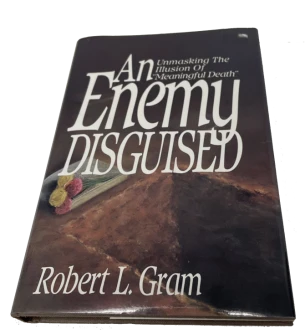
Non-Fiction: An Enemy Disguised
Published: 1985
An Enemy Disguised shatters this insidious hoax, myth by myth, lie by lie. In a day when "Death and Dying" classes are filled with attentive students and the dying process is considered the genial equivalent of a happy ending, Any Enemy Disguised carefully, methodically strips away the layers of soothing moral and scientific fallacies and half-truths.
This is an amazing and powerful read!
Sarah Sullivan - Amazon Reviewer
"A much needed antidote to ideas which militate against
the problematic nature of death and dying. Thoroughly researched,
it martials scientific, psychological, and spiritual understandings to the issue
of terminality, and provides historical antecedents to, what Gram calls, the
pervasive 'happy death' movement of the late 20th Century. Still relevant today,
and practical throughout, it helps the patient, as well as their loved ones, deal hopefully with life's endings."
Rev. Luis Perez