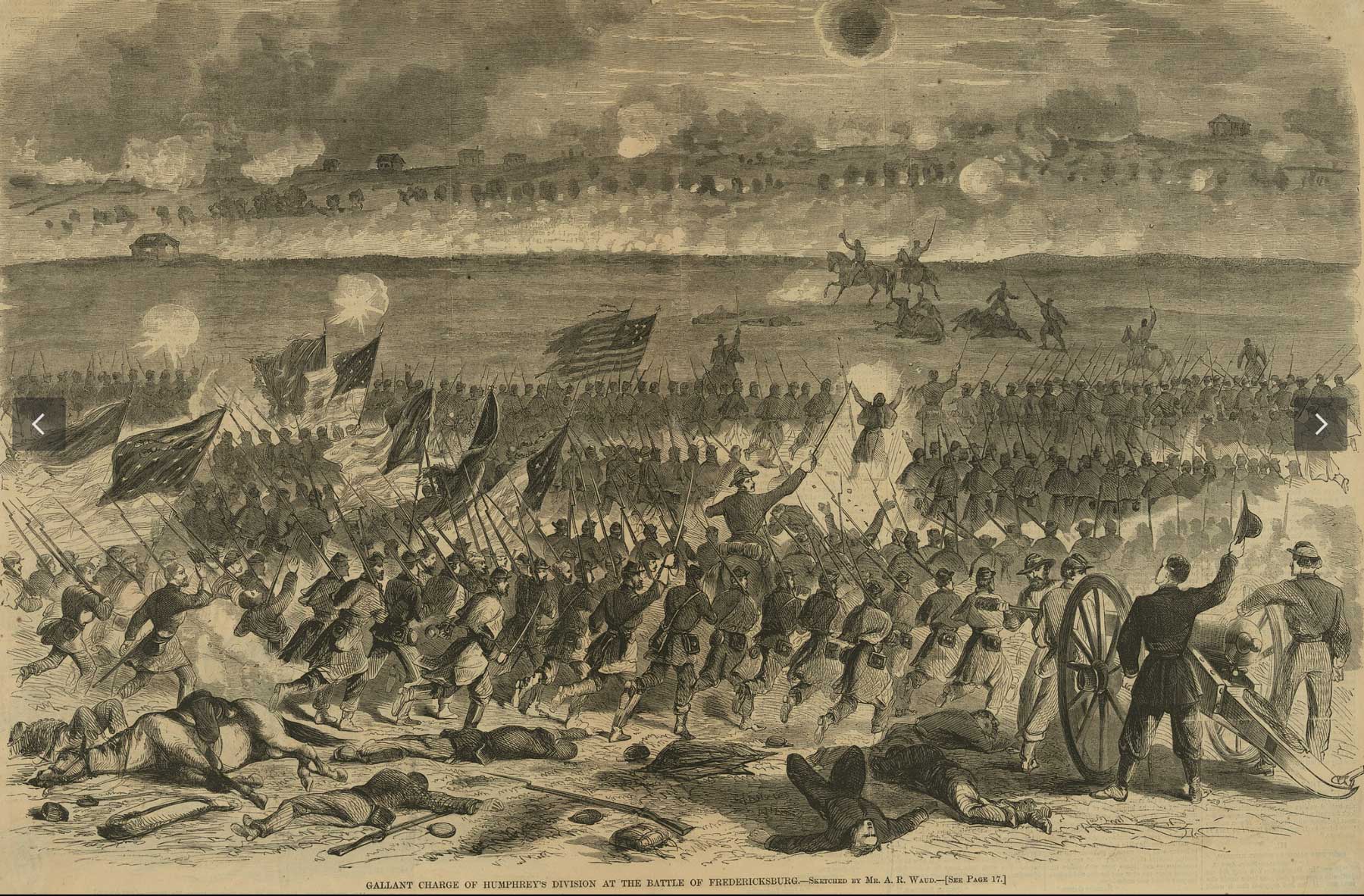
Humphrey's Charge was based on false information..
A soldier in Hancock's division reported movement in the Confederate line that led some to believe that the enemy might be retreating. Despite the unlikeliness of this supposition, the V Corps division of Brig. Gen. Andrew A. Humphreys, two brigades of green nine month regiments, was ordered to attack and capitalize on the situation. Humphreys led his first brigade on horseback, with his men moving over and around fallen troops with fixed bayonets and unloaded rifles; some of the fallen men clutched at the passing pant legs, urging their comrades not to go forward, causing the brigade to become disorganized in their advance. The charge reached to within 50 yards before being cut down by concentrated rifle fire. Brig. Gen. George Sykes was ordered to move forward with his V Corps regular army division to support Humphreys's retreat, but his men were caught in a crossfire and pinned down.[46] In the confusion, the horse of Brig. Gen. Abram S. Piatt stumbled and the general's back was seriously injured.
By 4:00 p.m., Hooker had returned from his meeting with Burnside, having failed to convince the commanding general to abandon the attacks. While Humphreys was still attacking, Hooker reluctantly ordered the IX Corps division of Brig. Gen. George W. Getty to attack as well, but this time to the leftmost portion of Marye's Heights, Willis Hill. Col. Rush Hawkins's brigade, followed by Col. Edward Harland's brigade, moved along an unfinished railroad line just north of Hazel Run, approaching close to the Confederate line without detection in the gathering twilight, but they were eventually detected, fired on, and repulsed.[47]
Seven Union divisions had been sent in, generally one brigade at a time, for a total of fourteen individual charges,[48] all of which failed, costing from 6,000 to 8,000 casualties.[49] A Union burial party found a total of 918 dead, many of them stripped naked by Confederates who had come down during the night to help themselves to their shoes and uniforms.[50][51] Confederate losses at Marye's Heights totaled around 1,200.[52] The falling of darkness and the pleas of Burnside's subordinates were enough to put an end to the attacks. Longstreet later wrote, "The charges had been desperate and bloody, but utterly hopeless." Hancock's division had taken the heaviest losses with 2,032 casualties, the most suffered by any Union division during the battle.[53] Thousands of Union soldiers spent the cold December night on the fields leading to the heights, unable to move or assist the wounded because of Confederate fire. That night, Burnside attempted to blame his subordinates for the disastrous attacks, but they argued that it was entirely his fault and no one else's.
A soldier in Hancock's division reported movement in the Confederate line that led some to believe that the enemy might be retreating. Despite the unlikeliness of this supposition, the V Corps division of Brig. Gen. Andrew A. Humphreys, two brigades of green nine month regiments, was ordered to attack and capitalize on the situation. Humphreys led his first brigade on horseback, with his men moving over and around fallen troops with fixed bayonets and unloaded rifles; some of the fallen men clutched at the passing pant legs, urging their comrades not to go forward, causing the brigade to become disorganized in their advance. The charge reached to within 50 yards before being cut down by concentrated rifle fire. Brig. Gen. George Sykes was ordered to move forward with his V Corps regular army division to support Humphreys's retreat, but his men were caught in a crossfire and pinned down.[46] In the confusion, the horse of Brig. Gen. Abram S. Piatt stumbled and the general's back was seriously injured.
By 4:00 p.m., Hooker had returned from his meeting with Burnside, having failed to convince the commanding general to abandon the attacks. While Humphreys was still attacking, Hooker reluctantly ordered the IX Corps division of Brig. Gen. George W. Getty to attack as well, but this time to the leftmost portion of Marye's Heights, Willis Hill. Col. Rush Hawkins's brigade, followed by Col. Edward Harland's brigade, moved along an unfinished railroad line just north of Hazel Run, approaching close to the Confederate line without detection in the gathering twilight, but they were eventually detected, fired on, and repulsed.[47]
Seven Union divisions had been sent in, generally one brigade at a time, for a total of fourteen individual charges,[48] all of which failed, costing from 6,000 to 8,000 casualties.[49] A Union burial party found a total of 918 dead, many of them stripped naked by Confederates who had come down during the night to help themselves to their shoes and uniforms.[50][51] Confederate losses at Marye's Heights totaled around 1,200.[52] The falling of darkness and the pleas of Burnside's subordinates were enough to put an end to the attacks. Longstreet later wrote, "The charges had been desperate and bloody, but utterly hopeless." Hancock's division had taken the heaviest losses with 2,032 casualties, the most suffered by any Union division during the battle.[53] Thousands of Union soldiers spent the cold December night on the fields leading to the heights, unable to move or assist the wounded because of Confederate fire. That night, Burnside attempted to blame his subordinates for the disastrous attacks, but they argued that it was entirely his fault and no one else's.